

Psychoanalysis and Fascism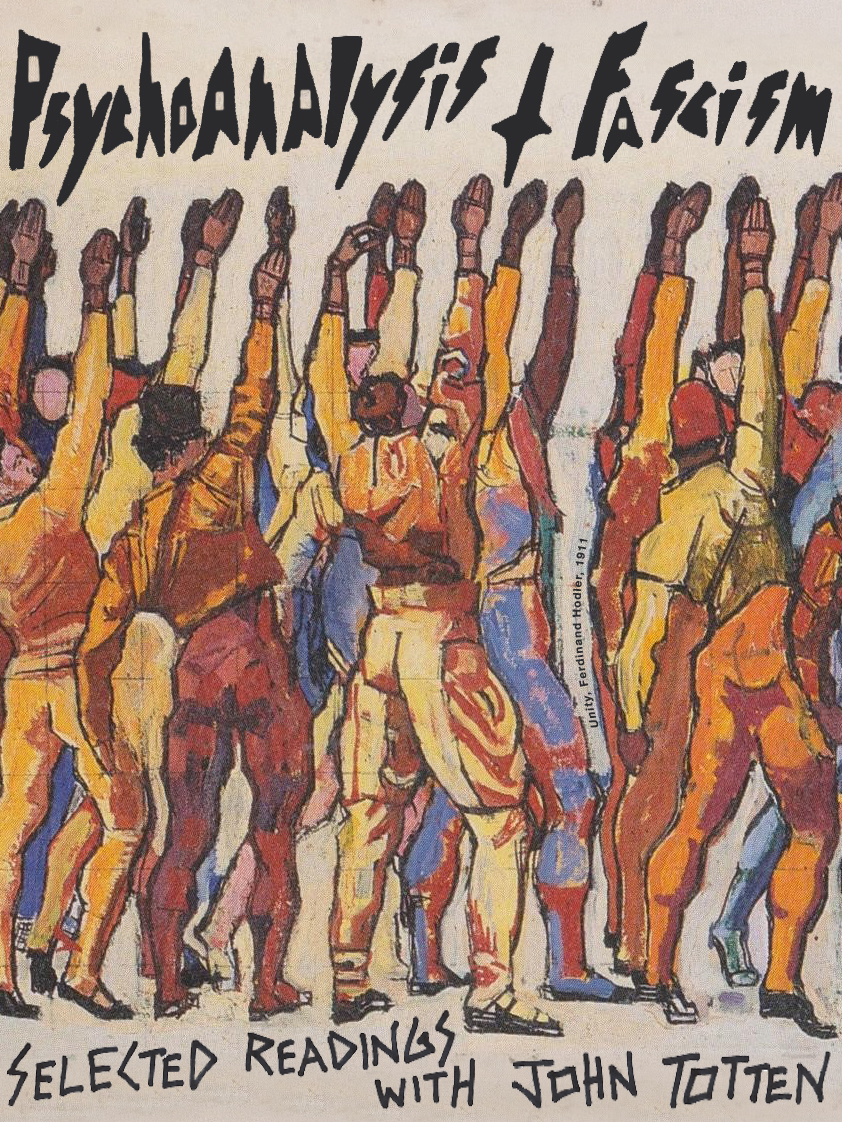
“Why do men fight for their servitude as stubbornly as though it were their salvation?”- Gilles Deleuze
A significant portion of psychoanalytic theory throughout the midcentury was dedicated to understanding fascism and has often been excommunicated from clinical canon.
This course seeks to understand why people become attached to their own servitude under authoritarian movements. Can domination itself be an object of desire? What role do repression, identification, fantasy, aggression, sexuality and the need for belonging play in authoritarian politics?
This survey examines major post-Freudian approaches to fascism, authoritarianism, ideology, desire and domination. It begins with the historical and conceptual problem of defining fascism and traces an intellectual progression from Freud through Reich, Fromm, the Frankfurt School, Lacan, Deleuze and Guattari, to the relational work of Jessica Benjamin.
Class Type: Course
Location: Totten House in Highland Park/West Seattle
Fees: Member $500 / Non-member $600
Max Capacity: 15
Learning Objectives:
- Describe the relationship between individual psychology and social structures, including the ways political, familial, and cultural environments shape subjectivity
- Evaluate psychoanalytic interpretations of political behavior
- Apply psychoanalytic concepts to questions of political identification, ideology, desire, domination and authority
References:
Adorno, T. W., Frenkel-Brunswik, E., Levinson, D. J., & Sanford, R. N. (1950). The authoritarian personality. Harper & Brothers.
Benjamin, J. (1988). The bonds of love: Psychoanalysis, feminism, and the problem of domination.Pantheon Books.
Deleuze, G., & Guattari, F. (1977). Anti-Oedipus: Capitalism and schizophrenia (R. Hurley, M. Seem, & H. R. Lane, Trans.). Viking Press. (Original work published 1972)
Eco, U. (1995, June 22). Ur-fascism. The New York Review of Books, 42(11), 12–15.
Freud, S. (1955). Group psychology and the analysis of the ego. In J. Strachey (Ed. & Trans.), The standard edition of the complete psychological works of Sigmund Freud (Vol. 18, pp. 67–143). Hogarth Press. (Original work published 1921)
Fromm, E. (1941). Escape from freedom. Farrar & Rinehart.
Griffin, R. (1991). The nature of fascism. Weidenfeld & Nicolson.
Lacan, J. (2006). Écrits: The first complete edition in English (B. Fink, Trans.). W. W. Norton. (Original work published 1966)
Marcuse, H. (1955). Eros and civilization: A philosophical inquiry into Freud. Beacon Press.
Paxton, R. O. (2004). The anatomy of fascism. Alfred A. Knopf.
Reich, W. (1970). The mass psychology of fascism (V. R. Carfagno, Trans.). Farrar, Straus and Giroux. (Original work published 1933)
Saketopoulou, A. (2026). Exigent sadism: Austerity logics and the antireparative turn. Social Text, 44(1), 25–51. https://doi.org/10.1215/01642472-12195785
Salberg, J. (2024). Don’t you see I’m burning?: Fascism amnesia and the failure of witnessing. Contemporary Psychoanalysis, 60(3–4), 209–220. https://doi.org/10.1080/00107530.2025.2540735
Stavrakakis, Y. (1999). Lacan and the political. Routledge.
Van Haute, P. (2001). Against adaptation: Lacan’s subversion of the subject: A close reading. Other Press.
Cancellation Policy: If you need to cancel your purchase, please do so before December 23, 2026, by emailing admin@nwaps.org to request a refund minus a 30% cancellation fee. We are unable to process or offer any refund for cancellations made after December 23, 2026. Allow 2-4 weeks to process your refund request. Note that participation in the entire event is required to obtain CE credits.
Speaker: John Totten, MA, LMHC
Speaker Bio: John Totten is a psychotherapist and clinical supervisor in private practice in Seattle. He is also the host of Between Us: A Psychotherapy Podcast, for which he received the International Forum for Psychoanalytic Education's Distinguished Educator award in 2024.


